

Leaders are rarely undone by a lack of technical knowledge. More often, the obstacle is internal conflict – the push and pull between different parts of ourselves that want incompatible things. You might have ambitious goals but an inner voice whispering “stay safe,” or a drive to push your team harder while also wanting to be liked. Unexamined, these competing selves create tension, sap energy and make decisions feel heavy.
This article explores research on internal conflict and the “inner critic,” offers practical exercises for bringing those voices into alignment and suggests how leaders can transform self criticism into self compassion through greater leadership self-awareness and emotional mastery.
Our identities are not monolithic. Psychologists describe a self standard system in which we compare our actual self against a desired self (who we want to be) and an undesired or feared self (what we hope never to become). Self regulation requires awareness of these standards; when the actual self falls short of our internal ideal or slips too close to a feared identity, negative emotions result.
Research shows that people maintain distinct approach and avoidance systems: one strives to move toward positive goals, while the other attempts to avoid negative outcomes. Conflicts arise when both systems activate simultaneously – such as wanting to lead a bold initiative (approach) while fearing failure and criticism (avoidance). These are common challenges addressed through effective leadership development programs.
A related concept is self criticism, sometimes called the “inner critic.” A 2025 qualitative study describes the inner critic as a strong, normative voice that acts as a block and draws upon past rejection, negative self schemes and defensive behaviours. Therapists have identified multiple types of critics – degrading, punitive, over demanding, neglectful, distant and domineering – each manifesting as harsh internal commentary or sabotage.
This inner critic originates in our threat protection system (a part of the brain that ensures survival by scanning for danger). The same study notes that a mammalian care giving system can soothe this threat response through self compassion and supportive social connection. When the critic is overactive, feelings of inadequacy and even self hatred can develop.
Many leaders discover through executive coaching that their inner critic is often the hidden barrier preventing confident decision-making and authentic leadership.
These internal conflicts do not stay private. MIT Sloan research warns that when a leader’s inner critic is unchecked, it spills over into group dynamics, causing stalemates, eroding trust and reducing creativity. The same article highlights Gallup data: when six out of ten employees feel their opinion matters, organizations see 12% higher productivity and 27% lower turnover.
In other words, a leader’s ability to manage their inner conflict directly influences their team’s performance, engagement, and overall organizational leadership effectiveness.

Think of your psyche as a team of parts, each with its own needs. Leading your inner team begins with recognising their voices:
These parts are not enemies. They formed to help you navigate experiences and avoid harm. The problem is that without conscious leadership, one part can dominate decisions and drown out others. The result is reactive behaviour – pushing too hard, procrastinating due to fear, overcommitting to please everyone – instead of thoughtful, values-aligned action and emotionally intelligent leadership.
Purpose: Identify patterns of internal criticism and their triggers.
Purpose: Activate the mammalian care giving system to calm the threat response.
Example 1: The Perfectionist Manager
Sarah, a high-performing manager, constantly hears an inner critic telling her she’s not prepared. This leads to over-preparation and micromanagement. Through journaling, she realises the voice echoes a past boss who ridiculed mistakes. By dialoguing with her critic, she acknowledges its fear of failure and sets boundaries. As a result, she delegates more and her team feels trusted.
Example 2: The Burnt-Out Founder
Alex, a start-up founder, is torn between expansion (Visionary) and survival (Protector). His inner critic devalues any rest as laziness. Using self compassion exercises, he recognises the critic stems from childhood messaging about worth being tied to productivity. He negotiates with his inner team, agreeing to schedule downtime and define clear metrics for growth. This integrated approach reduces anxiety, improves decision quality, and strengthens leadership resilience.
Example 3: The New Executive
Priya, recently promoted, pleases everyone to avoid conflict. Her inner critic fears she will be seen as incompetent. Through mapping her critics, she identifies a domineering critic that mimics an older sibling. She practices assertive self protection by respectfully voicing her opinions and learns that dissent can improve outcomes. Team engagement rises because colleagues respect her authenticity.

| Type of Inner Critic | Characteristics | Constructive Response |
|---|---|---|
| Degrading/Undermining | Belittles achievements and highlights flaws | Practice self kindness; celebrate small wins |
| Punitive/Accusatory | Focuses on guilt and punishment | Reframe mistakes as learning; set compassionate boundaries |
| Over Demanding/Controlling | Sets unrealistically high standards | Negotiate standards; recognise progress, not perfection |
| Subservient/Neglectful | Minimises your needs to prioritise others | Assertive self protection; honour your needs |
| Distant/Avoidant | Avoids emotions and vulnerability | Cultivate emotional awareness; share feelings |
| Domineering/Compensating | Masks insecurity by projecting superiority | Develop humility; acknowledge and integrate fears |
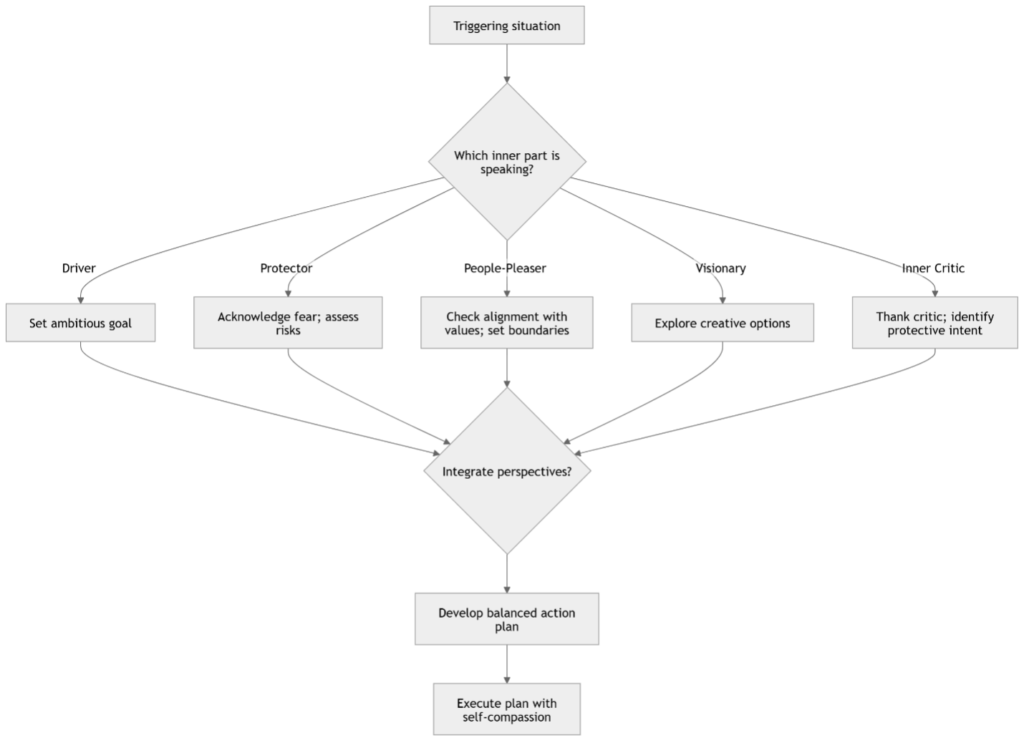
Leading your inner team is not about silencing dissenting voices but about integrating them. Self standards and self discrepancies play a central role in self regulation, and an overactive critic can derail both personal well-being and organizational performance.
By mapping your internal parts, engaging them in dialogue, and cultivating self compassion, you can transform internal conflict into constructive energy and become a more effective leader, coach, and decision maker.
Research on self criticism suggests that working actively with your inner critic – rather than ignoring it – leads to a more adaptive self and a flexible, dynamic self process. When leaders model this inner work, they create psychologically safe teams where others feel free to speak up, innovate and grow.

Behaviour change is a cornerstone of effective leadership and a key focus of successful corporate leadership training programs. Science shows that turning intentions into actions is less about willpower and more about smart design. Implementation intentions help you specify when, where, and how you will act, forging automatic links between cues and responses.
Emotional intelligence research reminds us that regulating our inner state is just as important as planning and practice. Leaders who understand and manage emotions positively influence team performance, build stronger relationships, and create healthier workplace cultures.
As you design your own behaviour change journey, remember to start small, choose consistent cues, and integrate emotion regulation into your plans. If you would like support applying these principles through leadership coaching and mindset development, feel free to contact me at alireza@altatc.ca.
Leading your inner team is not about silencing dissenting voices but about integrating them. Self standards and self discrepancies play a central role in self regulation, and an overactive critic can derail both personal well-being and organizational performance.
By mapping your internal parts, engaging them in dialogue, and cultivating self compassion, you can transform internal conflict into constructive energy and become a more effective leader, coach, and decision maker.
Research on self criticism suggests that working actively with your inner critic – rather than ignoring it – leads to a more adaptive self and a flexible, dynamic self process. When leaders model this inner work, they create psychologically safe teams where others feel free to speak up, innovate and grow.